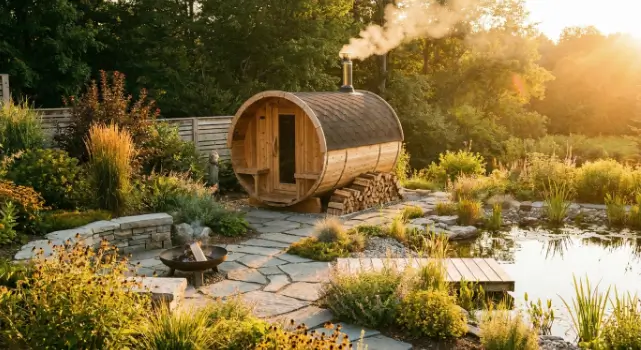
A compact two-person barrel sauna with a 6-foot diameter fits into roughly 60 to 90 square feet of usable backyard space once a service walkway and door clearance are accounted for, and the realistic all-in cost, including the unit, basic site prep, and electrical work, lands between $4,500 and $8,000. The unit price on a listing rarely includes everything a small yard actually needs to make the barrel usable, and skipping those line items is the most common way a backyard sauna project runs over budget.
How Much Ground Does a Barrel Sauna Actually Need?
A barrel’s diameter, not its length, drives most footprint decisions in a tight yard, since the barrel lies on its side across a cradle rather than standing upright like a cabin. A two-person model with a 6-foot diameter needs about 7 to 8 feet of clear width to leave room for the cradle beams and a narrow service path on one side for maintenance, and a additional 3 to 4 feet clear in front of the door for entry, exit, and a small bench or towel hook area. Larger barrels built for four to six people commonly run 7 to 8 feet in diameter and 8 to 10 feet long, which is a meaningfully bigger commitment in a small yard, so beginners with limited space should measure their actual clear area before falling for a bigger barrel’s per-person price efficiency.
What Does the Foundation or Pad Actually Cost?
Because a barrel sauna’s weight sits on the cradle rather than spread across a full footprint the way a cabin’s floor does, many small installations get by without a poured concrete slab. A level bed of compacted gravel, sometimes topped with paving stones, or a set of pressure-treated support pads under the cradle beams runs a few hundred dollars in materials and a weekend of labor for a handy homeowner, or $500 to $1,200 professionally done. Yards with poor drainage, a slope, or soft clay soil are the exception: a proper concrete pad in that situation, typically $1,500 to $3,000 depending on region and access, is worth the added cost to keep the cradle from settling unevenly over a few wet seasons.
What Clearances Does Local Code Actually Require?
Clearance requirements exist for real fire and heat-dissipation reasons, not just as red tape. Most manufacturers specify a minimum of 12 to 18 inches between an electric-heated barrel and any combustible wall, fence, or structure, and wood-fired heaters typically need more, often 24 to 36 inches, since they run hotter at the firebox. Property line setbacks are a separate question decided by local zoning rather than the manufacturer, and they vary enough between municipalities that it is worth a quick call to a local building department before finalizing placement, particularly in a small yard where the barrel is likely to sit close to a fence line by necessity.
What Do Delivery and Site Access Add to the Budget?
A fully assembled barrel sauna is heavy and awkward to move by hand, commonly 800 to 1,500 pounds depending on size and wood species, which means delivery access matters as much as the destination footprint. A yard reachable by a standard delivery truck and a gate wide enough for a hand truck or small equipment keeps delivery costs modest, often included or a few hundred dollars. A yard that requires crane placement over a house or fence, which is common with narrow side-yard access in dense residential lots, can add $500 to $1,500 to the project, and it is worth asking a retailer about access requirements before ordering rather than after a truck shows up and cannot get the barrel to the pad.
What Electrical Work Should a Small-Yard Buyer Budget For?
Most electric barrel heaters above roughly 6 kilowatts need a dedicated 240-volt circuit, and running that circuit from the panel to a backyard barrel typically costs $600 to $1,800 depending on distance and whether the panel has spare capacity. Smaller units under 4.5 kilowatts sometimes run on a lighter circuit, which trims the electrical bill somewhat, but it is worth confirming exact heater specs before assuming a cheaper hookup applies. This is the line item beginners most often forget to price before ordering, since it does not show up on the sauna’s product page at all.
Putting the Full Budget Together
Add it up for a typical small backyard installation: a two-person barrel with heater runs $3,500 to $6,000, a gravel or pad foundation adds $500 to $1,500, electrical work adds $600 to $1,800, and delivery adds anywhere from nothing to $1,500 depending on yard access. That puts a realistic all-in budget at roughly $4,500 to $9,000 for most small-yard buyers, well above the unit price alone. Shoppers building this budget from scratch can review dimensions, heater wattage, and delivery weight for specific models in the SweatDecks catalog before requesting site-specific delivery quotes, since those specs are what site-prep and electrical estimates actually depend on.
What Does the Broader Research Say About the Sauna Habit Itself?
Cost and footprint decide whether a barrel sauna fits a small yard at all, but the underlying interest for many buyers is the sauna habit itself. A 2018 review in Mayo Clinic Proceedings summarized cardiovascular and other health associations reported across a range of sauna studies. A 2018 systematic review in Evidence-Based Complementary and Alternative Medicine reached similar conclusions about regular dry sauna bathing. These are population-level associations, not a guarantee for any individual buyer, and they say nothing about barrel-specific benefits over cabin-style units, but they are the evidence base behind the broader claim that a small, well-placed sauna can be a worthwhile long-term addition to a tight backyard.
Frequently Asked Questions
What is the smallest footprint a barrel sauna needs in a backyard? A compact two-person barrel with a 6-foot diameter needs roughly 7 to 8 feet of clear width plus 3 to 4 feet in front of the door, totaling around 60 to 90 square feet.
Does a small barrel sauna need a concrete pad? Not always. A level gravel bed or pressure-treated pads under the cradle are often sufficient. A concrete pad is worth it on poor-draining or soft soil.
How much clearance does a barrel sauna need from a fence or house? Most manufacturers specify at least 12 to 18 inches for an electric heater and 24 to 36 inches for a wood-fired one.
What is the total realistic cost of a small backyard barrel sauna? A two-person unit with heater typically runs $3,500 to $6,000, plus $500 to $1,500 for site prep and electrical, for an all-in budget of roughly $4,500 to $8,000.
References
- Cardiovascular and Other Health Benefits of Sauna Bathing: A Review of the Evidence, Mayo Clinic Proceedings, 2018
- Clinical Effects of Regular Dry Sauna Bathing: A Systematic Review, Evidence-Based Complementary and Alternative Medicine, 2018
- Benefits and risks of sauna bathing, The American Journal of Medicine, 2001
- National Fire Protection Association, NFPA
By Renee Castillo
