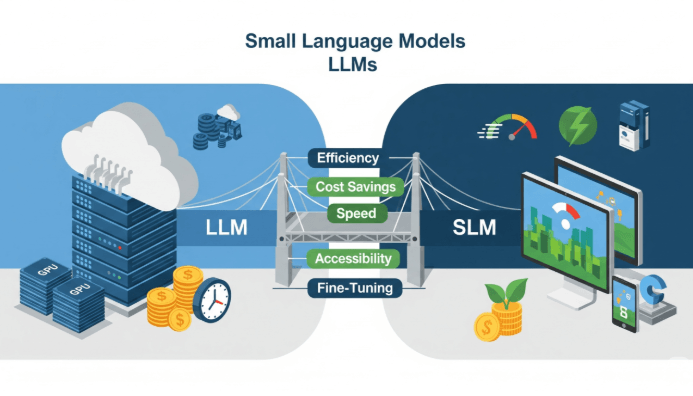
Artificial intelligence is steadily moving away from relying exclusively on cloud servers. More smartphones, laptops, wearable devices, and embedded systems are now capable of running AI directly on the hardware people use every day. This shift has created a demand for models that are not only intelligent but also efficient enough to operate within the limits of local processing power, memory, and battery life. As a result, developers are increasingly focusing on smaller, optimized language models that deliver practical performance without requiring massive computing resources.
Running AI locally offers several advantages. Users experience faster responses because requests no longer need to travel across the internet to remote servers. Sensitive information can remain on the device instead of being transmitted elsewhere, improving privacy in many situations. Local AI also continues functioning even when internet connectivity is weak or unavailable, making it especially useful for travelers, field workers, healthcare professionals, and industrial applications. These practical benefits explain why on-device AI has become one of the fastest-growing areas of artificial intelligence development.
Why Smaller Models Make Sense
Large language models have demonstrated remarkable capabilities, but their size often makes them difficult to deploy outside powerful data centers. They require substantial memory, high-performance graphics processors, and significant electrical power. While cloud infrastructure can provide these resources, smartphones, tablets, smart speakers, and edge devices simply cannot match that level of computing capacity.
Smaller language models are designed with efficiency in mind. Developers reduce unnecessary parameters, optimize architectures, and train models for specific tasks rather than attempting to solve every possible language problem. This targeted approach allows the models to deliver impressive results while consuming far fewer system resources. In many real-world applications, users care less about a model knowing obscure trivia and more about receiving quick, accurate assistance for everyday tasks.
One reason organizations are investing in small language models (SLMs) is that they strike a practical balance between performance, speed, and resource efficiency for devices that operate outside traditional cloud environments.
Lower Latency Creates Better User Experiences
Speed often matters more than people realize. Even small delays can make software feel sluggish or unreliable. When AI processing occurs directly on the device, users receive responses almost immediately because there is no need to send data to a remote server and wait for the results to return.
This reduced latency improves many everyday experiences. Voice assistants can respond naturally during conversations instead of pausing awkwardly between commands. Real-time translation applications become smoother because words are processed almost instantly. Smart cameras can recognize scenes and adjust settings without noticeable delay. Predictive text and writing assistance also become more responsive, creating a more seamless typing experience.
For applications that rely on continuous interaction, such as augmented reality, robotics, or autonomous systems, minimizing delays can be just as important as improving accuracy. Faster decisions often lead to more natural interactions and greater user confidence.
Improving Privacy and Security
Privacy has become a growing concern as AI systems process increasingly personal information. Many users hesitate to send conversations, documents, images, or health-related data to external servers, even when strong security measures are in place.
On-device AI reduces this concern by keeping much of the processing local. Personal information can remain stored on the user’s hardware instead of traveling across networks. While some applications still rely on cloud services for certain functions, handling routine tasks locally reduces the amount of data that must leave the device.
This approach also helps organizations comply with stricter privacy expectations in industries such as healthcare, finance, and government. Local processing cannot eliminate every security risk, but it can reduce exposure by limiting unnecessary data transmission.
Expanding AI Beyond Smartphones
Although smartphones often receive the most attention, on-device AI extends far beyond mobile applications. Automobiles increasingly use local AI to power voice controls, driver assistance systems, and navigation features. Manufacturing equipment relies on embedded AI to monitor machinery and detect maintenance issues before failures occur. Medical devices can analyze patient information locally to support healthcare professionals without requiring continuous internet access.
Smart home technology also benefits from local processing. Voice assistants, security cameras, thermostats, and appliances can perform routine tasks without sending every request to cloud servers. This not only improves responsiveness but also reduces bandwidth usage and enhances reliability during network outages.
As computing hardware continues to become more efficient, the number of products capable of running sophisticated AI locally will likely continue growing across numerous industries.
The Future of On-Device Intelligence
The future of artificial intelligence will probably involve a combination of cloud-based systems and local processing rather than choosing one over the other. Large cloud models will continue handling highly complex reasoning, extensive research, and computationally demanding tasks. Meanwhile, smaller models will increasingly manage everyday interactions that require speed, privacy, and reliability.
Researchers continue developing new optimization techniques, better compression methods, and more efficient training approaches that improve the capabilities of compact language models. As hardware evolves alongside these advances, the performance gap between smaller and larger models will continue narrowing for many practical applications.
For users, this means AI experiences that feel faster, more private, and more dependable without requiring constant internet connectivity. For businesses, it creates opportunities to build intelligent products that operate efficiently across a wider range of devices and environments. On-device AI is no longer simply a technical experiment. It is becoming a practical foundation for the next generation of everyday technology, and small language models are playing a central role in making that future possible.
